STEP 1
Complete an online health assessment
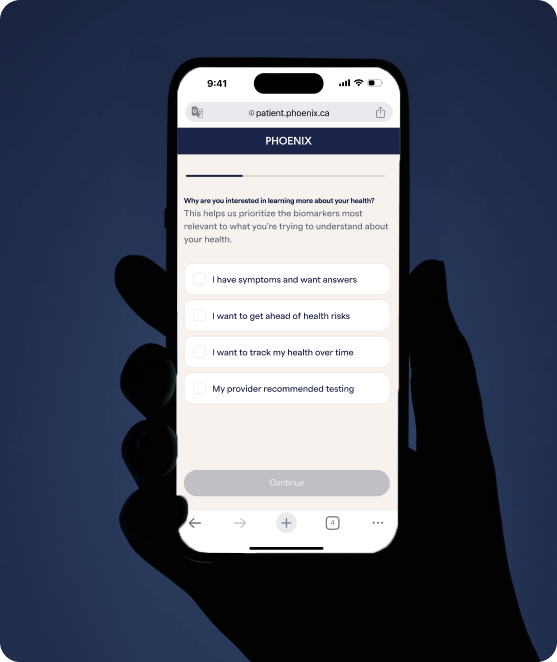
Skip the doctor’s office and answer a short, confidential health questionnaire.

Lab testing and licensed provider review.
Concerned about symptoms of low testosterone? Start with an online health assessment and blood testing. A licensed Canadian healthcare provider reviews your results and determines whether further care is appropriate. Available in Ontario.


Explore possible testosterone deficiency through laboratory testing and a licensed healthcare provider's clinical review, with next steps based on your results and medical history.
Why choose Phoenix?
Complete your health assessment
Answer a few questions about your health through our private online assessment.
Get your provider’s review
A licensed Canadian healthcare provider reviews your information and determines whether treatment is appropriate.
Receive your treatment, if prescribed
If prescribed, your medication is dispensed by a licensed Canadian pharmacy and delivered in discreet packaging.
Stay connected throughout your care
Message your provider through your Phoenix account for questions, updates, and follow-up care.
Free initial assessment
$0 · Always free
Follow-up visits
As needed
Skip the doctor’s office and answer a short, confidential health questionnaire.
A licensed Canadian practitioner will recommend a treatment plan.

Your treatment is shipped for free, directly to you in discreet packaging.

Your healthcare provider will follow up as part of your monthly consult.

A provider can review health information and laboratory results online. Some patients may also need an in-person examination or referral before any treatment decision.
A general comparison. In-person care varies by clinic and province.
Our team of licensed Canadian providers are dedicated to your health, bringing trusted expertise to every step of your journey.







The whole process was straightforward from the online assessment to delivery. Everything was clearly explained, and getting support when I had a question was quick and easy.
Read MoreI liked how easy it was to complete everything online without having to rearrange my day. Communication was clear, the experience felt private, and I always knew what the next step was.
Read MoreSigning up was much easier than I expected. The instructions were simple to follow, updates were clear throughout the process, and everything arrived discreetly at my door.
Read MorePhoenix's online testosterone assessment pathway is currently available in Ontario only. Eligibility and treatment decisions depend on individual clinical circumstances.
Don’t see your question?
Contact our support team.
Low testosterone, also called testosterone deficiency, means testosterone levels are lower than expected in the setting of relevant symptoms or signs. A diagnosis requires clinical assessment and blood testing.
A licensed Canadian healthcare provider reviews symptoms, health history and laboratory results. Blood tests, sometimes repeated, help determine whether testosterone deficiency is present.
Phoenix offers an online testosterone assessment pathway for eligible adults in Ontario. Blood testing and licensed healthcare provider review are required to determine appropriate next steps.
Symptoms can include changes in sexual desire or function, energy, mood and body composition. These symptoms are not specific to testosterone deficiency and may have other causes.
No. Fatigue, changes in mood and other symptoms can occur for many reasons. A healthcare provider considers symptoms alongside appropriately collected blood test results.
Testosterone levels can change over time and are influenced by age, health conditions and other factors. An age-related change alone does not necessarily mean prescription treatment is appropriate.
Yes. Sleep disorders, certain medications, illness and other health factors can influence testosterone levels or cause similar symptoms. Assessing these factors is an important part of care.
Testosterone levels vary, including by time of day and illness. A provider may recommend a repeat morning blood test to help confirm findings before diagnosing testosterone deficiency.
A healthcare provider interprets results with your symptoms and health history. If testosterone deficiency is not confirmed, they may assess other possible explanations and recommend different next steps.
Yes. Fatigue, mood changes and reduced sexual interest can have several possible causes, including sleep difficulties, medications and other health conditions. Symptoms alone cannot confirm low testosterone. A healthcare provider can assess your history and determine whether testing is appropriate.
Phoenix's testosterone assessment pathway is currently available to eligible adults in Ontario. A licensed Canadian healthcare provider reviews symptoms, medical history and available laboratory results before determining next steps. Assessment does not guarantee a prescription.
The Phoenix pathway may include a laboratory requisition for testing at a participating location. A licensed healthcare provider reviews results with your symptoms and medical history. Additional blood tests or an in-person examination may be needed.
A low result alone does not guarantee a testosterone prescription. Your healthcare provider interprets test results alongside symptoms, other conditions and relevant risks, then may recommend repeat testing, further evaluation or a different care pathway.
No. Testosterone treatment has important risks and contraindications. A provider considers your health history, relevant test results, fertility plans and possible need for further examination before prescribing.
Yes. Testosterone replacement can suppress sperm production and may affect fertility. Tell your healthcare provider if you want to conceive or preserve fertility before any treatment decision.
If treatment is prescribed, follow-up may include symptom review and blood tests to monitor testosterone and other health markers. Your provider determines the appropriate monitoring plan.
Answer a few questions about your health. A licensed Canadian provider will review them and decide whether a prescription is appropriate.